Characters
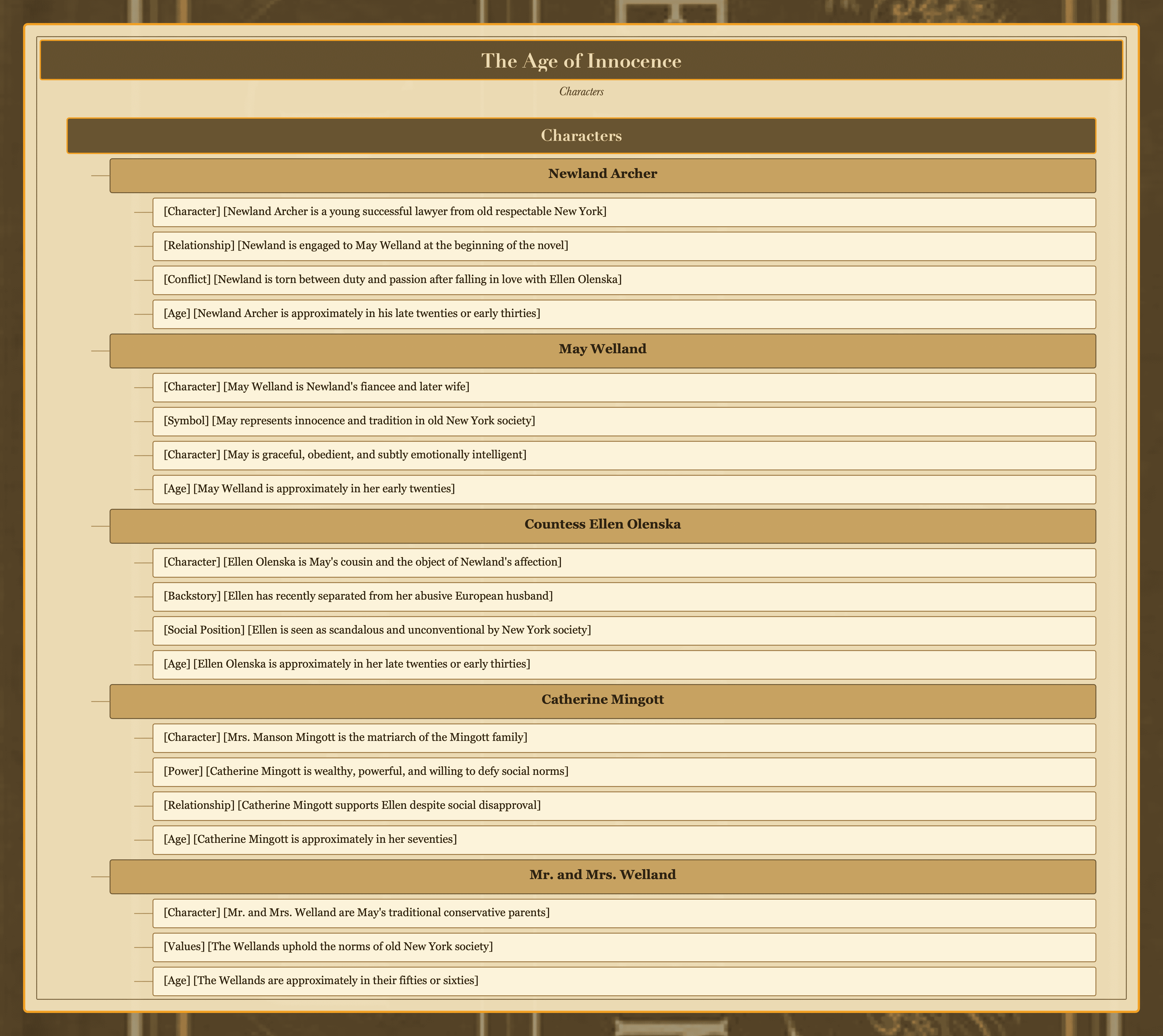
Newland Archer
- [Character] [Newland Archer is a young successful lawyer from old respectable New York]
- [Relationship] [Newland is engaged to May Welland at the beginning of the novel]
- [Conflict] [Newland is torn between duty and passion after falling in love with Ellen Olenska]
- [Age] [Newland Archer is approximately in his late twenties or early thirties]
May Welland
- [Character] [May Welland is Newland's fiancee and later wife]
- [Symbol] [May represents innocence and tradition in old New York society]
- [Character] [May is graceful, obedient, and subtly emotionally intelligent]
- [Age] [May Welland is approximately in her early twenties]
Countess Ellen Olenska
- [Character] [Ellen Olenska is May's cousin and the object of Newland's affection]
- [Backstory] [Ellen has recently separated from her abusive European husband]
- [Social Position] [Ellen is seen as scandalous and unconventional by New York society]
- [Age] [Ellen Olenska is approximately in her late twenties or early thirties]
Catherine Mingott
- [Character] [Mrs. Manson Mingott is the matriarch of the Mingott family]
- [Power] [Catherine Mingott is wealthy, powerful, and willing to defy social norms]
- [Relationship] [Catherine Mingott supports Ellen despite social disapproval]
- [Age] [Catherine Mingott is approximately in her seventies]
Mr. and Mrs. Welland
- [Character] [Mr. and Mrs. Welland are May's traditional conservative parents]
- [Values] [The Wellands uphold the norms of old New York society]
- [Age] [The Wellands are approximately in their fifties or sixties]
Plot Summary
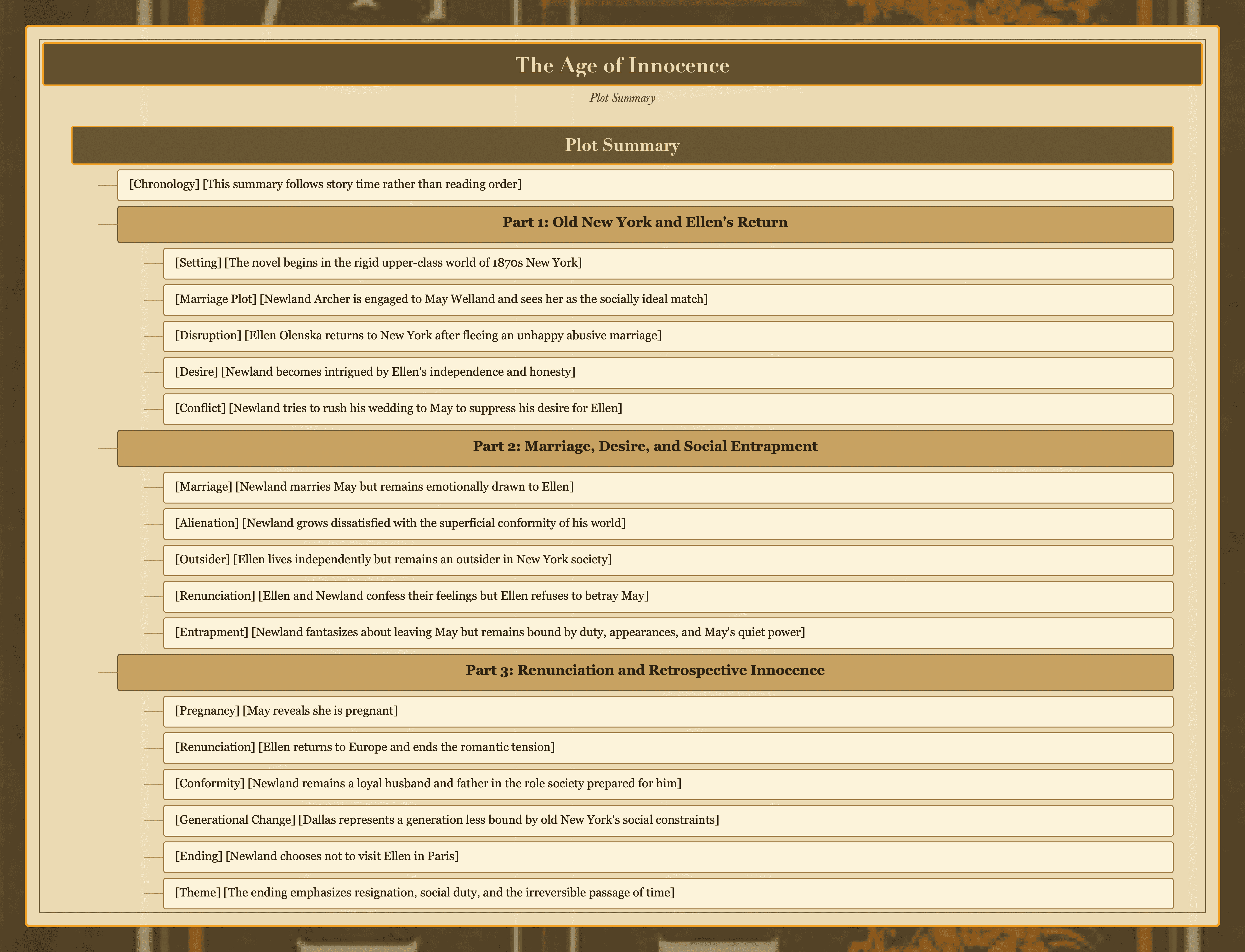
- [Chronology] [This summary follows story time rather than reading order] The novel's social revelations often arrive through delayed recognition and coded manners, but this plot summary orders the main events according to the implied chronology of Newland Archer's life.
Part 1: Old New York and Ellen's Return
- [Setting] [The novel begins in the rigid upper-class world of 1870s New York]
- [Marriage Plot] [Newland Archer is engaged to May Welland and sees her as the socially ideal match] May appears innocent, refined, and perfectly suited to uphold the values of their elite class.
- [Disruption] [Ellen Olenska returns to New York after fleeing an unhappy abusive marriage] Her arrival scandalizes society because divorce is treated as immoral.
- [Desire] [Newland becomes intrigued by Ellen's independence and honesty] Ellen's disregard for social convention makes Newland question marriage, society, and freedom.
- [Conflict] [Newland tries to rush his wedding to May to suppress his desire for Ellen] He attempts to remain within propriety by accelerating the very marriage that will trap him.
Part 2: Marriage, Desire, and Social Entrapment
- [Marriage] [Newland marries May but remains emotionally drawn to Ellen]
- [Alienation] [Newland grows dissatisfied with the superficial conformity of his world]
- [Outsider] [Ellen lives independently but remains an outsider in New York society]
- [Renunciation] [Ellen and Newland confess their feelings but Ellen refuses to betray May] Ellen wants freedom and love, but she understands the scandal and heartbreak their relationship would cause.
- [Entrapment] [Newland fantasizes about leaving May but remains bound by duty, appearances, and May's quiet power]
Part 3: Renunciation and Retrospective Innocence
- [Pregnancy] [May reveals she is pregnant] This ends Newland and Ellen's possibility of escape. May's pregnancy binds Newland to marriage, family, and social duty.
- [Renunciation] [Ellen returns to Europe and ends the romantic tension]
- [Conformity] [Newland remains a loyal husband and father in the role society prepared for him]
- [Generational Change] [Dallas represents a generation less bound by old New York's social constraints]
- [Ending] [Newland chooses not to visit Ellen in Paris] He remains outside her apartment and preserves the memory of love rather than confronting what might have been.
- [Theme] [The ending emphasizes resignation, social duty, and the irreversible passage of time]
Semiotics
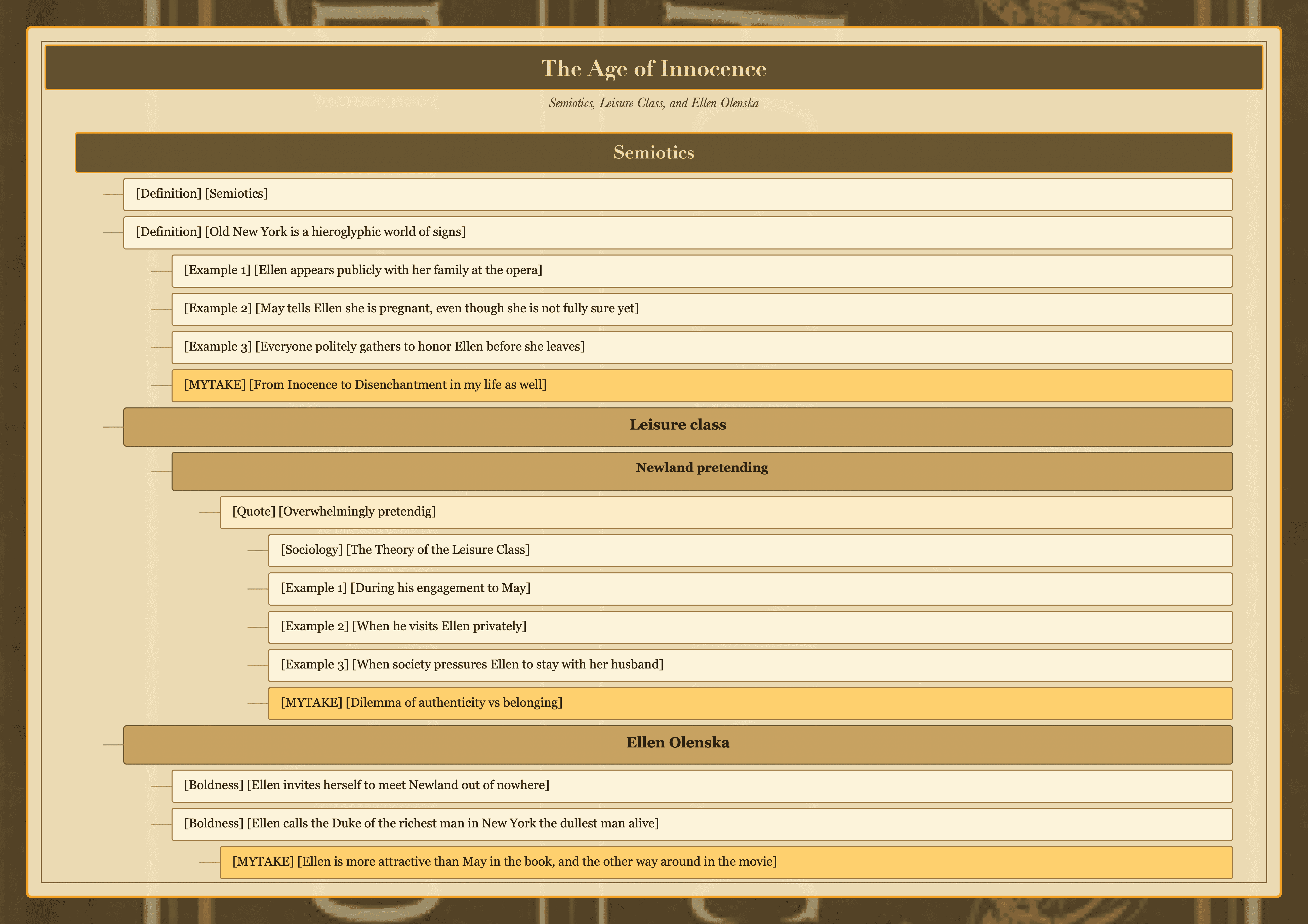
- [Definition] [Semiotics] Semiotics studies how things communicate meaning beyond their literal function
- [Definition] [Old New York is a hieroglyphic world of signs] A hieroglyphic world where the real thing was never said, done, or even thought, but only represented by an arbitrary set of signs.
-
- [Example 1] [Ellen appears publicly with her family at the opera] What it means: The family is signaling that she is still socially protected, despite her scandalous separation.
-
- [Example 2] [May tells Ellen she is pregnant, even though she is not fully sure yet] What it means: It silently ends Ellen and Newland’s possible escape. The pregnancy becomes a socially perfect, morally untouchable trap.
-
- [Example 3] [Everyone politely gathers to honor Ellen before she leaves] Old New York wants Ellen to leave because she threatens the social order: she is separated from her husband; she considered divorce; she has an emotional bond with Newland; she does not fully obey New York’s codes; her presence exposes the hypocrisy of their marriages and manners. By the farewell dinner, the group has effectively decided: Ellen must disappear so the marriage, family reputation, and social order can remain intact. But they do not say “we are expelling you.” They say it through politeness: a dinner, smiles, formal respect, and affectionate goodbyes.
-
- [MYTAKE] [From Inocence to Disenchantment in my life as well] I think something similar to The Age of Innocence happened in my life as well. For example, suppose I go on a Tinder date with a girl that claimed to me that her father left her before she was born, right? At 14 years old, I would think, Oh, her father left her. It's a sad thing, what a prick, how could he be so irresponsible. Maybe she had bad luck, but when you go from innocence to cynicism, you know the story is way deeper. Her father left her because her father wanted to get laid, had sex with her mother, got her pregnant, had no interest in a relationship with her, left her as if she was nothing, married a girl more beautiful than her. So basically her whole life trajectory got heavily influenced because she had an ugly mom, which is a very dark, dark thing that happened. And then what else? And this also has to do with politics because, as Freud would say, the main driver of the human is libido. Therefore, the person, her father, had libido that wasn't controlled by society or directed to a more virtuous, fruitful project, such as working, or volunteering, or doing community work at church. And yeah. So innocence is about receiving information and not being able to connect the dots well enough to the point of understanding that that information that you received as causes has a lot of evil AND SUFFERING. When you reach that point you already moved to Disenchantment.
Leisure class
Newland pretending
-
[Quote] [Overwhelmingly pretendig] “The real loneliness is living among all these kind people who only ask one to pretend!”
-
- [Sociology] [The Theory of the Leisure Class] In status-driven societies, Maslow’s need for belonging is obtained by Veblenian pecuniary emulation
-
- [Example 1] [During his engagement to May] He performs the role of the ideal fiance: loyal, proper, socially approved. Inside, he is already restless and drawn toward another kind of life.
-
- [Example 2] [When he visits Ellen privately] He pretends his concern is moral and family-based, but his interest is emotional and erotic. He hides desire under the language of duty.
-
- [Example 3] [When society pressures Ellen to stay with her husband] Newland pretends to defend convention, even though he increasingly sees that convention is being used to imprison her.
-
- [MYTAKE] [Dilemma of authenticity vs belonging] Newlad has two options, either fake it, go against his will and his own beliefs of what is natural/correct, or be sincere and expelled. A Dillema between his need for belonging + high class attatchments (like fine dining) vs what his heart feels right
Ellen Olenska
- [Boldness] [Ellen invites herself to meet Newland out of nowhere]
- [Boldness] [Ellen calls the Duke of the richest man in New York the dullest man alive]
-
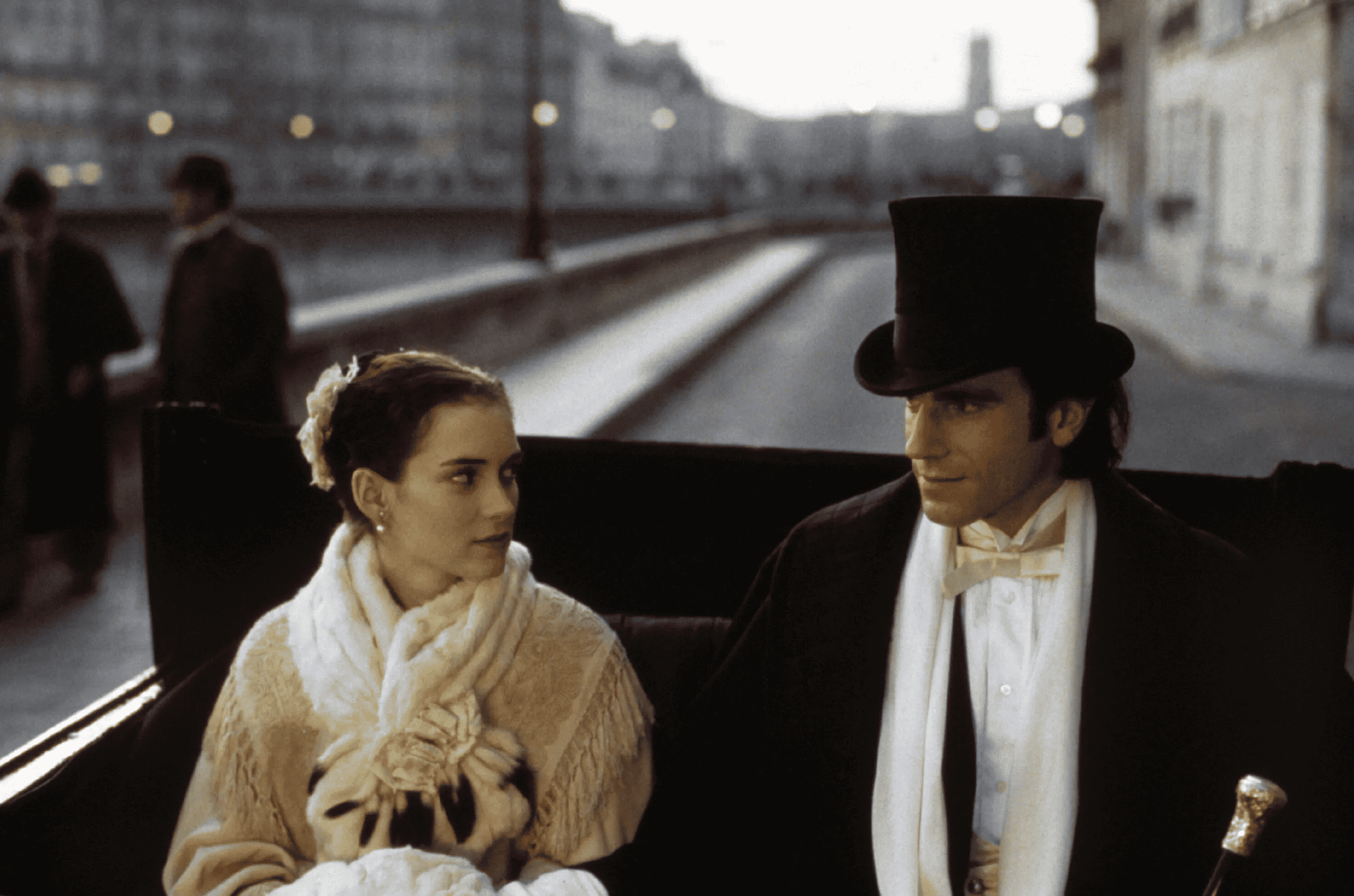
- [MYTAKE] [Ellen is more attractive than May in the book, and the other way around in the movie] When I first watched the movie, I fell in love with Wynona Ryder because she is gorgeous, but now I am falling in love with Ellen because she is odd, bold, free-spirited, and unwilling to bow to New York's rigid standards of form and taste. One is attractive due to character, and the other is attractive due to appearance.
Other
- [History] [Edith Wharton was the first woman to receive the Pulitzer Prize]
- [Misreading] [The novel is often misread as a costume drama] Like wedding dresses, the novel can be mistaken for a merely decorative period piece.
- [Marriage Plot] [The novel stages marriage as the beginning of complex life rather than the happy ending]
-
- [MYTAKE] [Heartbreaking for me] Since I irationally heavily idolizes marriage, I feel sad by having informations such as this.
- [Reception] [The Age of Innocence was initially considered a vain simple story]
-
- [MYTAKE] [I agree this book is kind of vain simple story]
- [America's growth does not remove its felt aesthetic inferiority to Europe]
-
- [MYTAKE] [That felt very weird to me] Because I couldn't even imagine something as fancy as old fashioned New York, and they themselves feel inferior to Europe. That feels very crazy.
No comments have been added to this post so far, be the first to add one comment!